
A Pacific paradise few have seen
[ad_1]

The Marshall Islands was recently listed as one of the world’s five least visited countries. But tourism could help fade the scars of a troubled past for the 29 stunning coral atolls.
Sylvester Clement had been swinging his
machete to clear the dense bamboo blocking our trail when he turned his
attention to an overgrown area to our left. A few moments later he revealed a
rusting Japanese tank – a hidden relic of World War II. “I found this here two
weeks ago,” he said. “You’re the second person to see it.”
It is not surprising that the tank remained
undiscovered for so long. Floating in the Pacific Ocean about midway between
Hawaii and Australia, the Marshall Islands was recently listed as one of the
five least
visited countries in the world, with only 5,000 annual visitors. The
international airport in the low-key capital Majuro is served by an irregular
and expensive United Airlines “island-hopper” flight that makes a slow journey from
Honolulu and Guam. The islands are also feeling the severe effects of climate
change, with rising sea levels meaning that the Marshall Islands residents may
become the world’s first climate change refugees in the coming decades. But for
those who make it here now, the 29 atolls and thousands of low-lying islets of
the Marshall Islands offer a fascinating insight into remote island life.
The fact that a young man like Clement had
a job taking care of tourists is a rarity in the Marshall Islands, where the illusion
of an island paradise is quickly revealed to be skin deep. After several
decades of Japanese rule, the Marshall Islands fell under American control in
1945, at the end of World War II. It was on Bikini, one of the northern atolls,
that the US military detonated 67 nuclear bombs between 1946 and 1958 as part
of the atomic weapon test programme. The residents of Bikini and nearby atolls were
evacuated, and tightly knit communities were squeezed onto already crowded
islands that were ill equipped to deal with newcomers. Those atolls remain
uninhabited even today, with residual radiation levels rendering long-term
consumption of locally grown food hazardous to human health.
Although the Marshall Islands achieved
independence in 1986, their economy remains heavily dependent on the US as part
of the Compact
of Free Association relationship, which ensures financial assistance in
exchange for full US military authority. Natural resources on the overcrowded
islands are inadequate and a large part of the population lives in poverty,
while a diet of mostly processed food has led to high rates of obesity and
diabetes. Unemployment is endemic, with more than 50% of people out of work and
relying on the government for basic support. With very little industry and few
commercial links to the outside world, there are not many prospects for young
people – although tourism could help.
“We have the biggest shark sanctuary in the
world. We have pristine lagoons, perfect atolls; we have great diving and
surfing,” said Ramsay Reimers, owner of one of Majuro’s few hotels. “The biggest problem is
the skill shortage. We have to get what we need from outside. Our doctors come
from the Philippines, our nurses from Fiji.”
It was during a visit to Reimers’ private
island of Eneko, which is open to locals and hotel guests, that I was taken for
a walk by Clement. His job is to look after guests who come to the island on a
day-trip from Majuro or choose to stay in one of the island’s three bungalows. Clement
is a graduate of Waan Aelõñ in Majel (WAM), a not-for-profit
organisation on Majuro set up by local boat-builder and social entrepreneur Alson Kelen in 2000, that helps young Marshallese with both
vocational training and life skills.
The idea for WAM started when Kelen saw
that one of the island’s most distinctive traditions – building the Marshallese
canoes that for centuries had sailed thousands of miles across the Pacific to
islands as far away as Hawaii with which they traded – had nearly been lost.
The knowledge of older islanders was not being taken up by the younger
generation.
“I thought to myself, instead of keeping
written archives of Marshallese canoes, why not create a living record?” he
said. At the same time, Kelen saw that children were dropping out of school and
teenage pregnancy rates continued to climb. By offering a practical course that
preserved local traditions, he could also help curb some of the islands’ endemic
problems.
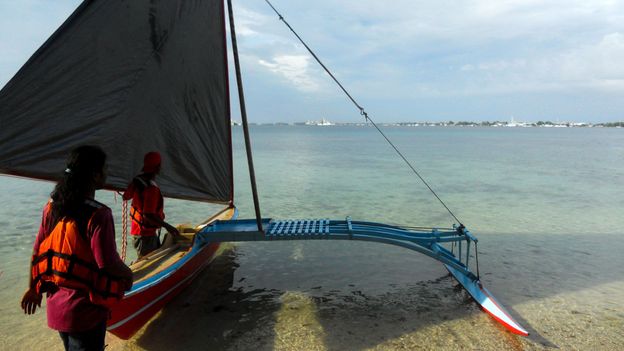
Visitors to WAM are able to book a trip in a
Marshallese canoe, and I eagerly took advantage of the opportunity, marvelling
as Linton Baso, a WAM student, gently steered the vessel across the Majuro
lagoon. Back on dry land, Kelen described his recruitment process as a reverse
interview, where he looks for teenagers with the bleakest prospects. During each
six-month programme, around 25 students are taught basic life skills, including
English and maths, and given rudimentary training in applying for jobs. Many of
the students speak no English, and those from the outer islands often arrive in
Majuro with no social security number or birth certificate.
The canoes built during the programme are
being put to good use. As well as providing a rare source of tourism revenue
for the islanders by taking visitors out on the water, they enable WAM students
to become expert sailors and in turn to pass on their knowledge of navigation
and woodcraft to youngsters on the more remote atolls.
The work done at WAM is also invaluable for
the few private enterprises in Majuro. With no higher education available in
the Marshall Islands, students must travel to the US to receive education
beyond high school level; and many of the young graduates remain in the US and
work there. Teaching young people valuable local skills such as carpentry can
lead to a decreased dependency on imports and aid, as well as an increase in
tourism infrastructure that will result in better job opportunities and
revenues.
On the boat ride back from Eneko, I was
directed to jump into the lagoon with my snorkel mask. There, in no more than a
few metres of water, I was stunned to discover a sunken DC3 aircraft and
alongside it a military helicopter. As with so many of the treasures of the
Marshall Islands, they lie just below the surface but are well worth the effort
of exploring.
[ad_2]
Source link


