
Living in: Cities of the future
[ad_1]

Showcasing the cutting edge of urban planning, these five metropolises may help determine the way we will live, now and in decades beyond.
Although
they may all look very different, the cities of the future share a new way of
doing things, from sustainable buildings to walkable streets to energy-efficient
infrastructure. While some are not yet complete – or even built – these five locations
showcase the cutting edge of urban planning, both in developing new parts of an
existing metropolitan area and building entirely new towns. By 2050, it is
forecast that 70% of the world’s population will live in cities. These endeavours
may help determine the way we will live then, and in decades beyond.
Songdo, South Korea
Constructed 60km south of Seoul on land reclaimed from the Yellow Sea, Songdo is
the world’s leading example of an aerotropolis, a city that has been built
around the airport as opposed to the hub being consigned to the outskirts of
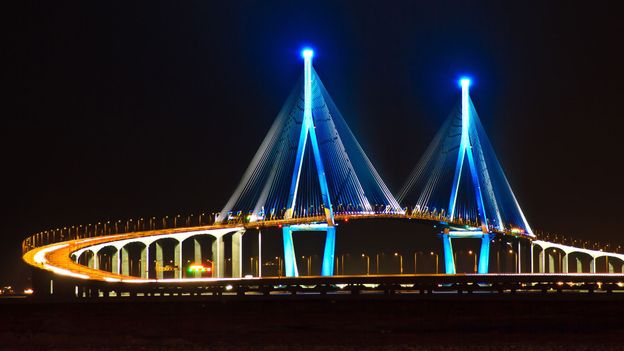
town. Connected to Incheon International Airport by the 12km-long Incheon Bridge,
Songdo is just an 80-minute flight from Shanghai and an hour and a half flight from
Tokyo; it is designed to be a gateway to the rest of Asia for international
corporations and their employees. At more than 50% complete, Songdo is on track
to be one of the greenest cities in the world, with more than 40% of the city
devoted to parkland, including the 100-acre Central Park. Songdo will also use radically
less water and electricity than a traditional city of the same size and emit
two-thirds less greenhouse gases. The UN recently announced that its Global Climate Fund will be based in a tower block built specifically for
international agencies, and 500 employees and their families will move to
Songdo, starting this year. The distance any resident has to walk or bike to a
store, business or school has been carefully calculated, so that cars are not
needed. By the time the city is finished in 2017, it will have 65,000 residents
and 300,000 daily commuters, mainly from Incheon and Seoul.
While the general economic turndown affected
South Korea’s entire housing market, sales are starting to recover, with 5% of Songdo
housing set aside for expat and non-Korean purchasers, said Mary Lou DiNardo, a
spokeswoman for the Songdo International Business District. “There are charming garden residences, sleek low-rise
loft spaces in Songdo’s Canal Walk and state-of-the-art high-rise
apartments and penthouses with views of the Yellow Sea and the Incheon Bridge,”
DiNardo explained.
All properties are sold as condominiums,
and typically have three bedrooms, as is common in the Korean culture where one
is for the parents, one for the kids and one for the grandparents. An apartment
in the high-end towers Central Park I and II cost 373,000 and 386,000
Korean won per square foot respectively.
Lofts along Canal Walk are around 700sqft to 1,000sqft and cost around 227,000
won per square foot.
Masdar City, United Arab Emirates
This gleaming example of sustainable urban living just 17km east of Abu Dhabi
is currently more university and business campus than metropolis, but when Masdar City
is complete in 2025, it will be home to 40,000 residents and 50,000 commuters. The
city’s master plan, designed by the architects Foster + Partners, put roads underground
(and bans cars that use petrol), allowing for very narrow pedestrian streets that
capture and funnel the breezes, aided and shaded by thick city walls, a technique
Arab builders have used for centuries. The city’s modern elements come in the
renewable energy and clean tech sources being developed at the Masdar Institute
of Science and Technology, which currently houses 250 students on campus. The
city is completely powered by renewable energy sources such as solar, and the
buildings are being constructed with recycled materials, including steel and aluminium.
Energy and potable water demands have been reduced by more than 50%, using a
quarter of the energy of a conventional city the same size. “We are addressing social, economic and environmental
sustainability and also making sure it’s affordable,” said Omar Zaafrani, communications manager for Masdar
City.
The building
that houses both the Masdar and International Renewable Energy Agency
headquarters will have stores and restaurants in addition to office space, powered
by 1,000sqm of photovoltaic panels. While
no residential buildings beyond dormitories have been built, they are in the
works. “There are various residential plots around the city, and over the
coming years they will be tendered out to global architects,” Zaafrani explained.
The city’s economic free zone – with zero taxes, import tariffs or restrictions
on foreign hires – is set up to specifically attract clean energy and tech
companies, clustering them together in incubator office buildings. “The number
one target is people who work in Abu Dhabi and around the UAE,” Zaafrani said.
“We are trying to make sure as we build up the city, there will be demand for
both commercial and residential spaces.” Currently, a four-bedroom villa in
central Abu Dhabi rents for around 200,000 dirhams a year, while a two-bedroom
flat in Reem Island rents for around 100,000 dirhams. Over the next two years, 45,000
new flats and houses will come available.
Former Expo Site, Shanghai
Rather than building an entirely new city (although China is doing that too, by the dozens), Shanghai is taking
the area that housed the 2010 Shanghai World
Expo on the Pudong and Puxi sides of the Huangpu River and turning it into
a city-within-a-city. While the Expo originally displaced 18,000 families, it
was themed around urban sustainability and efficiency, and the city invested
heavily in the site’s infrastructure so it could be redeveloped after the fair
was over and the pavilions dismantled. Parks, green space, water features and
cultural institutions – such as the large red China Pavilion, now a museum – were left to be incorporated into
mixed-use projects containing apartments, hotels, offices, shopping malls and
restaurants. By 2016, two hotels and some office and retail space will be
completed, and in May 2013 the 50,000sqm Green Valley project broke ground. Near the China Pavilion, the
project will form the central axis of the overall site with sustainable
commercial space, restaurants and offices, all linked by open courtyards,
gardens and other green spaces.
The Shanghai housing market is rising quickly, and
recently the government reacted to fears of a bubble by directing banks to stop
giving mortgages to people buying their third home. The median house price in
the city centre is currently 42,500 renminbi per square metre, and a new-build,
two-bed flat in Pudong can start at 8 million renminbi. A one-bedroom city
centre flat rents for about 6,000 renminbi per month, and a three-bed in the
centre rents for 14,500 renminbi.
Victoria, British Columbia
This Canadian city across the Puget Sound from Seattle, Washington, has created
an urban experiment within its borders with the Dockside Green development on the city’s harbourfront. The three neighbourhood master
plan is based on the tenets of New Urbanism, with its focus on density, community and
sustainability. Dockside Wharf
has been completed, and Dockside Commons and Dockside Village are not yet under
construction. Streets are walkable, housing is diverse and energy efficient, and
residential and commercial spaces are densely packed but close to nature trails
and ponds. The three developments and 26 buildings, designed by Perkins + Will
Architects, are LEED platinum certified and built on a former industrial site. Strong
eco-credentials include the fact that the buildings use 55% less than water
than traditional condos and were constructed using low VOC paint and
eco-friendly materials such as bamboo flooring and carpets made from recycled
material.
This phase
of the development is currently sold out, with most buyers attracted by the
fact that the eco-friendly, walkable area that already feels like a true community.
About 30% of buyers are from other areas of Canada seeking a milder climate,
and roughly 20% are first-time buyers who work in the area. “The rest are young
families and couples, retirees and investors,” said Lorraine Wilson, a media
relations consultant for Vancity, the credit union developing the area. Almost
90% of housing stock is one- and two-bedroom residences with an average cost of
500 Canadian dollars per square foot, and a two-bedroom flat rents for 2,000 Canadian
dollars a month.
Sherford, Devon
Nearly 10 years after the creation of Poundbury, a Dorset county town built to
high-density, mixed-use principles similar to New Urbanism, Prince Charles and the
Prince’s Foundation for Building Community
also became involved in the master planning of Sherford, a
new market town in Devon that was approved in 2007 but stalled until May 2013,
when the UK government announced a £32 million loan to kick-start the construction.
Located on the outskirts of Plymouth, Sherford will have typical Georgian-style
architecture, but very high-tech, energy efficient buildings, four schools, a
health centre, a sports centre, a church, a town hall and a library, plus
wildlife corridors to replace the land and hedgerows that are being removed. A 500-acre
park will contain two wind turbines that will power the town. When completed,
the town will have 5,500 homes and house 12,000 residents, plus 83,000sqm of
retail and office space. A completion date for the project has not yet been
set.
Sherford
will provide affordable and market rate flats and houses, along with social
housing. House prices in and near Plymouth have remained relatively steady the
past year. Currently the average house price in Plymouth is £158,000 and the
average price of a flat is £117,000.
Correction: A previous version of this article incorrectly stated the name of the Global Climate Fund. This has been fixed.
[ad_2]
Source link


