
Macau beyond the roulette wheel
[ad_1]

More than a decade after the Portuguese left Macau, their 450-year-old legacy lives on in fusion with the Chinese, creating a culture that is distinctly Macanese.
Peer across the
smoky gambling tables and the lines of slot machines in Macau’s crowded casino
halls, and there is little doubt as to what the greatest attraction is for the
majority of the 28 million people who visit this Special Administrative Region
of China each year. Yet beyond the neon façade, Macau has much more to offer.
The Portuguese
controlled Macau for almost 450 years and in that time built churches,
fortresses and grand homes in the distinctive architectural style of their
motherland. When Macau was returned to China in 1999, many locals expected the
new rulers to gradually erase the legacy of the European colonial days. But Chinese
authorities quickly realised that Macau’s unique heritage holds enormous potential
to promote the region as a tourist destination. In the last decade, the Chinese
have renovated many buildings in their original Portuguese style, installed
typical early 20th-century Portuguese streetlights and made every
effort to celebrate Macau’s colourful history.
A stroll through
the historic district’s narrow cobblestone streets makes it easy to see the
fusion of Chinese and Portuguese that created such a distinct Macanese culture.
Shops selling fresh egg tarts that could have come straight out of a Lisbon
bakery are found alongside stalls with bak
kwa, wafer-thin slices of marinated dried meat; colonial European buildings
are decorated with bright red Chinese lanterns; even within the Catholic
churches there are paintings of the Madonna and child, both with unmistakably
Asian features and dressed in flowing Chinese silk robes.
Street signs
meanwhile display names in Cantonese and Portuguese, with the two versions not
always sharing the same meaning; the Portuguese wanted to commemorate historical
figures by naming streets and alleys in their honour, but the Chinese did not always
hold them in the same high esteem.
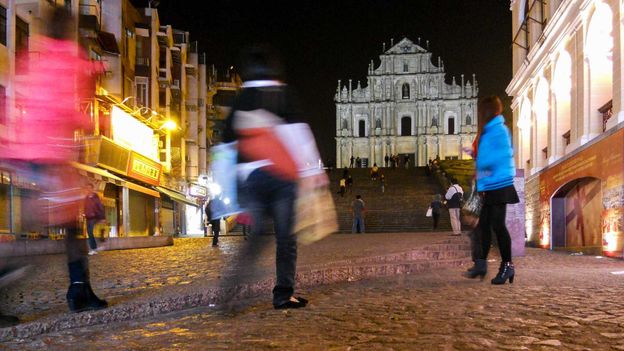
The most prominent landmark in Macau, beyond the garish glitz of the
modern casinos, is the ruin of St Paul’s Church, a 17th-century
Jesuit church that was destroyed by fire in 1835. All that remains is the
elaborately carved façade, which dominates the skyline of old Macau, with the
long set of steps leading up to the church crowded by Chinese visitors posing
for photographs using it as a backdrop.
Above the site of St Paul’s Church and overlooking the South China
Sea is a stone fortress, also built by the Jesuits in the 17th
Century to defend Macau from attacks. The building now houses the Museum of Macau, a
comprehensive collection of artefacts from before and after the arrival of the
Portuguese. There are 16th-century maps, reconstructed streets made
up of typical Chinese and Portuguese houses and cultural items such as puppets that
shine a light on old Macanese life.
The most striking exhibit is a recreation of a cricket fight, demonstrating
how the Chinese would bet on the outcome of a battle to the death between the two
insects. The crickets were even tickled with a straw stick before a fight to
increase their aggression. A champion cricket was feted as a hero and would be buried
in a special casket after it had fought its final battle. Perhaps this display
provides the strongest hints as to the roots of Macau’s gambling culture.
For a long time
the Portuguese allowed Macau to decay slowly, reluctant to invest more than
necessary in this distant outpost. Yet in the run-up to the handover of Macau to
the Chinese in 1999, the Portuguese government took a renewed interest, keen to
ensure a lasting legacy once their time in Macau was over. Cobbled streets, for
so long put together with spare rubble from the city’s crumbling buildings,
were renovated with the same high quality stone used to pave the streets of
central Lisbon. Old buildings were restored to their former glory. Public
statues were erected to commemorate Portugal’s role in Macau’s history; the
most prominent example being the Friendship Statue at the foot of St Paul’s
Church, featuring a Chinese girl handing a lotus flower (a symbol of purity) to
a young Portuguese man.
Chinese visitors
to Macau have embraced the island’s Portuguese heritage, with a strong interest
in trying Macanese cuisine, a fusion of Chinese and Portuguese influences. At Restaurant Litoral, southwest of the historic district, diners
tuck into African chicken, a fiery dish brought to Macau by Portuguese sailors
and made using spices such as chilli and paprika that they collected on their lengthy
sea voyage to Asia. The Espacio Lisboa restaurant (Rua
das Gaivotas; No 8 R/C) in Coloane village is
popular for a leisurely lunch break, offering such authentic Portuguese dishes
as garlic prawns and bacalao (cod) fishcakes.
Most
accommodation in Macau is geared towards providing instant access to the casino
floor, but visitors looking to get away from the hustle of the strip can stay
in the Pousada de Sao Tiago, a 17th-century
fortress that was originally built to defend Macau against local pirates. It
was acquired by local tycoon Stanley Ho in 2004 and renovated to create 12
suites overlooking the harbour. While the rooms are thoroughly modern, the
entrance to the property is through a long stone tunnel that remains just as it
was 400 years ago. The hotel’s Chapel of St James, built within the original
fort, is a highly sought-after venue for weddings.
The obsession
with gambling in Macau is so strong that it is easy to speculate that many
visitors would not even notice if the city’s historical and cultural heritage
was quietly removed overnight. Yet, look a little closer and it is clear that
even more than a decade after the Portuguese left Macau, their legacy carefully
and faithfully lives on.
[ad_2]
Source link


