
The Titanic’s final resting place
[ad_1]
Features correspondent

Beneath the handsome lighthouses, sweet fishing villages and multicoloured forests of Atlantic Canada lies a wild history of pirates, ghosts and shipwrecks.
The headland of Cape Race juts out into the Atlantic like a determined chin. Giant waves hurl themselves at its black volcanic sides, spraying water hundreds of feet in the air. A stocky, red-topped lighthouse stoically rotates its lamp, showing a subtle glimmer in the daylight. It is a scene of desolate beauty, a green-topped spit of land standing fast against the shearing ocean winds.
This cape on the far southeastern edge of
Newfoundland is a forgotten corner of the world, home to just two lighthouse
keepers and an itinerant family of harbour seals. Yet less than 100 years ago,
this was one of the most important places in the Western world, where the
famous Cape Race telegraph station relayed breaking news and messages between
Europe and New York via an ingenious system of undersea cables. It was a vital
hub of communications in an age when the staccato bleeping of Morse code was
the very cutting edge of technology.
On the evening of 14 April 1912, the
station received a radio transmission that would, for a short time, make Cape
Race a household name. It was 10.25pm, and the message was ‘CQD MGY’.
The international distress call of CQD was,
at the time, being phased out in favour of the new SOS, but the radio operators
at Cape Race knew its significance. A ship was in serious trouble out on the
frigid North Atlantic waters, and there was no mistaking which one – MGY was
the unique call sign of the magnificent RMS Titanic.
John Myrick’s finger taps out Morse code
with extraordinary accuracy and speed. A 73-year-old former radio operator,
he’s holed up in the cosy, red-painted Cape Race radio hut, which no longer
houses a relay station but is now a small museum devoted to the history of
telegraphy.
‘It was a closely guarded secret at the
time, but it’s become generally known that my great uncle Jim was the one who
received the Titanic distress call,’ says John. ‘He was an apprentice operator
and he rushed out to get the officer in charge. Afterwards, he was sworn to
secrecy and could never tell that he had been left alone there even for a
moment. He was 14 years old.’
Despite the furious work of the radio
operators, the Titanic’s situation was hopeless. Several ships steamed to its
rescue but the nearest, the Carpathia, did not arrive for more than four hours.
By that time, the world’s largest and most luxurious liner had sunk into the
freezing water, taking with it the lives of those who could not fit into its
few lifeboats – 1,517 passengers and crew.
The tragic sinking has resonated down the
years, but while the Titanic was the most famous vessel to founder off the
Newfoundland coast, this area – with its sharp rocks, treacherous icebergs and
heavy seas that can tear a ship apart – is known as ‘the Graveyard of the
Atlantic’. Thousands of sunken vessels litter the seabeds of the whole region,
stretching across to Nova Scotia and New Brunswick – evidence of an
extraordinary history of maritime disasters, filled with tales of brave fishermen,
wily smugglers and bloodstained privateers.
John drives west from Cape Race on the
rough unpaved road that runs along the coast of the Avalon Peninsula – a series
of rocky bluffs interspersed with sheltered coves, each with a cluster of fine
white houses. These are old fishing villages, where settlers were once drawn to
the stupendous shoals of fish that lived off the coast – cod so thick in the
water that, in the words of the explorer John Cabot in 1496, one could ‘walk
across their backs’. Generations of enthusiastic overfishing have seen these stocks
critically reduced, but back in the 16th and 17th centuries, rich fishing
vessels plied these waters, attracting the attention of prize-hungry
buccaneers.
Trepassey is now a quiet seaside town where
holidaymakers come to paddle in the dark aquamarine water, and it’s unlikely
that those walking along its black, stony foreshore would know of its place in
pirating lore. In 1729, the dread pirate Black Bart, known for his natty
clothes and plumed scarlet hat, arrived in the bay here, plundering and burning
21 merchant ships in the village harbour before setting sail for the West
Indies.
Bloodthirsty brigands such as William Kidd
and Henry Morgan are also known to have terrorised ships on these waters, and
may have left a greater legacy than a few sunken shipwrecks. ‘There was a man
called Myrick who was part of Morgan’s crew, so I might have some pirate
blood,’ John says with an infectious cackle. ‘But the story is that he turned
traitor and sold out Morgan to the British, so ancestor or not, I’d have made
him walk the plank.’
To the west of Newfoundland is New
Brunswick, where great forests of maples, poplars and larches are busy turning
bright shades of red, gold and fuchsia in the chilling air. On the province’s
eastern flank, a broad river – the mighty Miramichi – empties into the sea, and
it’s here that US presidents, visiting dignitaries and Hollywood stars like
Jack Nicholson regularly come for a bit of peace and quiet. They stand up to
their thighs in water and cast rods in the tree-dappled sunlight, hoping to
catch one of the salmon that the river is famous for – so large, locals say,
that the fish will gobble up squirrels that fall into the water.
The river flows into the broad, flat
Miramichi Bay, which is sheltered from the wider Gulf of Saint Lawrence by a
string of low-lying islands. Water laps gently against the shore; there is
barely a breeze. It’s a far cry from the foggy, wild coasts of Newfoundland,
but even here, stories of man’s struggle with the sea pervade. This area bears
the legacy of one of Canada’s worst maritime disasters when, in 1959, a
hurricane swept in and destroyed much of the local salmon-fishing fleet.
Theodore Williston has been fishing these
waters since the age of five, when his uncle first taught him how to set a net.
Now 80 years old, he still heads out in his boat every day, bringing in mostly
rock crab and small fish called smelts. He settles into a seat in a
wood-panelled restaurant overlooking the water and recalls in a strong, clear
voice his experience of that night.
‘The weather report was bad, but the
fishermen went out anyway,’ he says. ‘I was one of them. The storm came up late
in the evening and it was the roughest I ever saw. Hundred-mile-an-hour winds.
I can’t tell you exactly how high the waves were because I might be lying, but
about 30 feet. Boats were tossed over, upside down.’
His sentences are short and direct, as if
scripted by Hemingway. He pauses as his breakfast arrives – a hearty plate of
eggs and fried potatoes – before continuing his story. Theodore and his crew
worked to rescue men from the stricken boats, but 22 vessels sank and 35 men
were drowned.
‘I was lucky,’ he says. ‘A lot of the guys
that drowned were experienced fishermen. There was no rhyme or reason. The
largest boat was lost, the smallest lost. A 13-yearold boy, a 75-year-old
captain.’ He shakes his head, silent for a moment. ‘I don’t know why I
survived. Maybe it was as my mother believed – everything is pre-planned. Who
knows?’ He shrugs and gives a sudden smile, gesturing out over the water, where
a lone bald eagle can be seen trailing lazy circles against a clear blue sky.
Folks say the conditions that occurred that
night are rare – ‘Won’t happen again in a lifetime,’ according to Theodore –
but 100 miles or so to the south, where the lower edge of New Brunswick meets
the Bay of Fundy, the colossal power of these seas is demonstrated as regular
as clockwork.
Groups of chatty walkers make a clanging
noise as they descend the metal stairs to reach Hopewell Rocks, a motley
collection of sandstone outcrops on a muddy beach against a high, green-fringed
cliff. These have each been sculpted into shape over aeons by a twice-daily
rush of 100 billion tonnes of water flooding into the bay – enough to overflow
the Grand Canyon.
As the sky darkens into dusk, the tide
begins its advance and visitors are ushered up the stairs by a
fluorescent-vested park ranger – the beach is no longer safe. The overlapping
waves stream over the brown sand and begin their climb up the rock face, higher
and higher, until the whole surface of the bay has risen almost to the cliff’s
edge – an extraordinary 46 feet. With each tide, a hundredth of a millimetre is
washed and carved from the oddly shaped rocks, gradually changing the landscape
with a constant, inexorable force that will continue until the cliffs
themselves are worn away.
It’s
7.45pm at The Five Fishermen, a high-end seafood restaurant in the city of
Halifax in Nova Scotia, and a roomful of people are tucking into platefuls of
lobster thermidor and seared Atlantic salmon. It is a stylish eatery, fitted
out with polished wood and an eclectic range of décor – a huge British coat of
arms, an antique dingy and a stained-glass window from a French nunnery – and
not one of the customers seems in the slightest bit perturbed that they are
dining in a room that used to store dead bodies.
This fine old building on Argyle Street has
a colourful history – as Canada’s first public school, then as a well-regarded
art school – but its most famous incarnation was as the John Snow and Co
Funeral Home. It catered to the dear departed of Halifax for decades, but is
best known for its role as the site where victims of the Titanic disaster were
brought after being recovered from the sea.
Once news had broken that the Titanic had
been lost, three ships from Halifax Harbour were commissioned to go out into
the treacherous, ice-packed waters and retrieve the bodies. Upon their return,
the rigid class system practised on board the Titanic in life was observed in
death: the wealthiest victims were embalmed and carefully stored at John
Snow’s, while the poorer were sent to the nearby curling rink to be
refrigerated on the ice before all were buried in nearby cemeteries.
‘People ask about it all the time,’ says
Sandra Gardner, the restaurant manager, ‘asking if it’s true that the Titanic
victims were here, where all the bodies were kept, whether their spirits
linger…’ She pauses for dramatic effect. ‘And they do.’
It
turns out that working at The Five Fishermen is not for the faint-hearted.
Countless tales of ghostly encounters are reported by the staff – cutlery
moving on tables, taps turning themselves on and off, unexplained voices,
shoulder-tappings and whisperings in the ear. Then there’s the sightings – a
translucent, grey-haired man in an old-fashioned frock coat on the stairs; a
little girl with sad eyes in the bathroom.
When asked how many spirits were in the
building, a visiting psychic reported that there were 76. ‘I don’t find it
frightening at all,’ Sandra says with a grin. ‘We’re all friends here, the
ghosts and the staff. We get along well. I talk to them all the time. “How’s
everybody doing today?” I say.’
Halifax has always been a busy port town,
and never more so than today – the industrial harbour to the city’s west is a
bulky congregation of tankers, container ships and cruiseliners. Yet down on
the historic waterfront, people stroll along a wooden boardwalk among outdoor
cafés and vintage-style huts selling fresh battered cod and chips, while new
and restored classic boats bob gently in the harbour.
In the midst of the waterfront is the
Maritime Museum of the Atlantic, where curator Gerry Lunn is busy setting up an
exhibition to commemorate the centenary of the Titanic’s sinking, highlighting
the efforts of the crewmen who pulled the victims’ bodies from the sea. A
permanent display of salvaged artefacts already draws hundreds of thousands of
visitors each year – a number that rose significantly after the 1997 release of
James Cameron’s Titanic movie and shows no sign of dropping.
‘Any story that involves the loss of human
life is compelling,’ Gerry says, ‘and the Titanic is one of the best-known
disasters of that kind. But the sad fact is, it’s one in a long line of
tragedies in this region, and these continue to happen. Scratch the surface of
families in some areas and you’ll discover brothers, uncles and fathers lost in
the sea.’
Along this coast is a slew of fishing
villages and coves with the idyllic charm to inspire a thousand watercolour
paintings – from Lunenburg, with its brightly painted houses, to the perfect
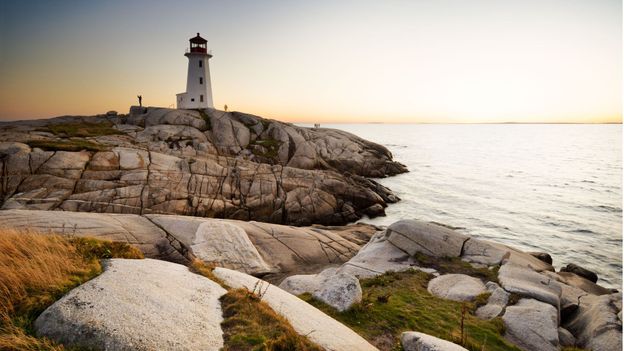
lighthouse setting of Peggy’s Cove – yet each has a steely core that has seen
it withstand centuries of assault by seas, winds and storms. Echoing this
resilience are the hardy fishermen – the ‘iron men in wooden boats’ of local
lore – who, despite the risks, continue their traditions and head out day after
day into the unforgiving waters. ‘
In the fishing communities, there are deep
roots going back through the years – a toughness that’s passed on from father
to son – and there’s a great feeling of pride in that,’ Gerry continues. ‘But
there is also an underlying sense of the ocean as a living, breathing thing
that can take revenge if you show hubris or don’t give it due respect. It’s
like the old saying goes – you should never turn your back on the sea.’
Correction: In an earlier
version of this story, the photo caption stated that the lighthouse pictured is in Cape Race,
Newfoundland instead of Peggy’s Cove, Nova Scotia. It has been corrected.
[ad_2]
Source link


